Tiānjīn · 天津市
Trade route · Sea terminus · 9 concessions · Tea warehouse on the Bund · Finale

Tiānjīn

天津市 · Tiānjīn

Where ocean steamers were loaded with tea, the empire met the world

九国通商·茶仓终焉

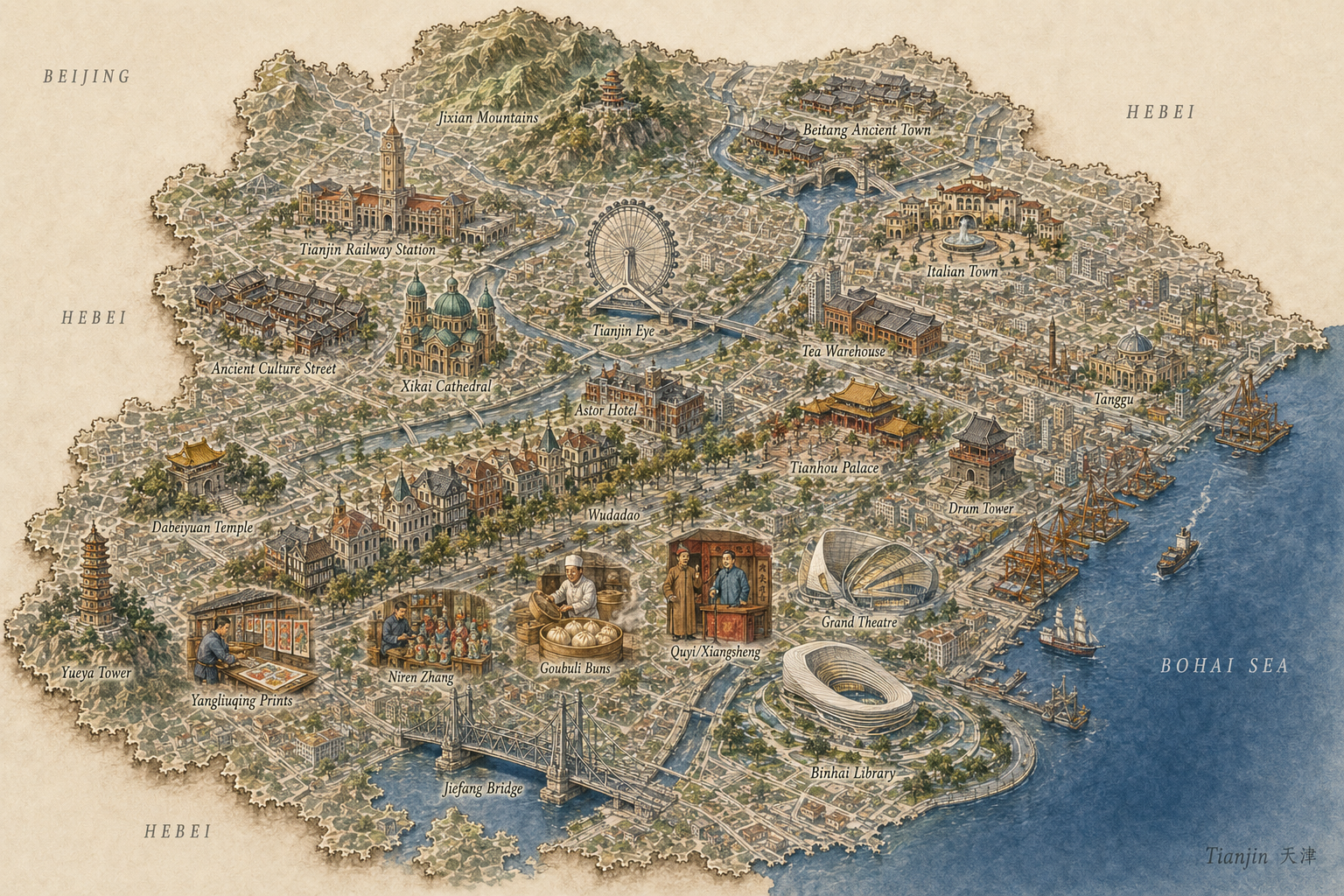
Tianjin — the sea terminus of the Great Tea Route, the finale of the 32-map series. In the concession era (1860–1945), the British, French, German, Italian, Japanese, Russian, Austro-Hungarian, Belgian, and American concessions turned the city into a kaleidoscope of architectural styles. The tea warehouse on the Haihe (天津茶仓) — the place where European merchants, Chinese compradors, and steamer captains arranged tea exports to London, Hamburg, and New York. Route: Five Avenues (Wudadao) with European villas → Italian Quarter → Tea Warehouse → Tianhou Temple → Drum Tower → 1000-year-old Guifabang oven → Goubuli dumplings → Quyi comic theatre.

Teas of this area

Морской экспорт-чай 海运出口茶

During the concession era, Tianjin exported 30% of China's tea to Europe and America. The tea warehouses on the Haihe — Tea Warehouse (天津茶仓) — gathered tea from all provinces, packed it into waterproof containers, and loaded it onto steamers. Route: Tianjin → Hong Kong → Singapore → London. A 90-day journey.

Сладкий чай хаккского стиля Северного Китая 北方甜茶

Tianjin sweet tea — a hybrid of British afternoon tea and Chinese tradition: black tea with milk and sugar, served with Goubuli biscuits. Popular in Wudadao — the former British and French concessions.

Театральный чай Цюйи 曲艺茶

Quyi (曲艺) — Tianjin's traditional comic theatre, performed in tea houses. Xiangsheng (相声, comic dialogue) — the main genre. Tea as part of the performance: every 20 minutes the teapot is refilled, and the audience 'beats' applause on the table.

Route by days

  1. Дни 1–2

    Удадао · Пять Авеню 五大道·英租界

    Concession kaleidoscope

    Wudadao (五大道, 'Five Avenues') — the former British and French concessions, 230 mansions in 5 different styles: English brick, French neoclassical, Italian Renaissance, German Art Nouveau, Spanish. The Xiao Dezhan Mansion Museum — a reconstruction of the life of a Chinese comprador who grew rich from the tea trade. A tea session in the English Tea Room — British afternoon tea with Chinese varieties. A bicycle tour along the 5 avenues.

    Boutique hotel in a 1920s mansion — stucco, fireplace, parquet

  2. День 3

    Итальянский квартал · Площадь 意大利风情区

    The only Italian concession in China

    The Italian Quarter (意大利风情区) — the only Italian concession outside Italy. Piazza Marconi with a fountain and a statue of Marconi (inventor of radio, an Italian). Restoration of Renaissance villas. A tea session in an Italian café with Chinese teas — a fusion of cultures. The noted architect Paul Bonetti (1908) — built the quarter's main buildings.

    Italian villa-hotel — frescoes, Tuscan breakfast

  3. День 4

    Чайный склад · Хайхэ 天津茶仓·海河

    Heart of maritime export

    The tea warehouse on the Haihe (天津茶仓) — a historic warehouse building where tea was gathered for maritime export. Museum of the tea trade: contracts of British companies (Jardine Matheson, Butterfield & Swire), steamer route maps, samples of tea bricks, packaging tablets. A reconstruction of the role of the comprador (买办) — the Chinese intermediary between Western traders and suppliers. A tea session on the warehouse roof overlooking the Haihe — the place where steamers were loaded. A comparison with the Shanghai Bund — two sea terminals.

    Boutique hotel by the Haihe

  4. День 5

    Тяньхоу Гун · Древние храмы 天津天后宫·鼓楼

    The city's oldest temple

    Tianhou Gong (天后宫) — the temple of Mazu (sea goddess), 1326, the oldest temple in Tianjin. Patroness of sailors and fishermen — especially venerated in a port city. Offerings of tea to the goddess — a tradition before a long sea voyage. The Drum Tower (鼓楼) — 15th century. Ancient Culture Street (古文化街) market — calligraphy, jade artefacts, tea sets. Dabei Yuan Si (大悲院) — a Buddhist monastery with offerings.

    Guesthouse in the Old Town

  5. День 6

    Глаз Тяньцзиня · Современность 天津之眼·滨海图书馆

    Ferris wheel · Library-eye

    Tianjin Zhi Yan (天津之眼, 'Eye of Tianjin') — the world's only Ferris wheel built into a bridge across a river. Height 120 m, views of the Haihe and the Old Town. Binhai Library (滨海图书馆) — 'Eye of the Sea', a futuristic library with a giant sphere-theatre inside, the most photogenic library in the world. A tea session on the upper floor of the tower. Modern Tianjin as a contrast to the historic concessions.

    Modern Binhai hotel

  6. День 7

    Гоубули · Цюйи · Финал серии 狗不理·曲艺剧场

    Folk culture · Finale of the 32 maps

    Goubuli (狗不理) — Tianjin's famous baozi dumplings with 18 pleats, 160 years of history. Demonstration of making + tasting with Tianjin sweet tea. Quyi theatre — traditional xiangsheng and kuaiban. Final tea session — closing of the 32-map series: teas from all 32 regions on one table, from Wuyi Dahongpao to Tianjin export tea. The Great Tea Route completed: continental (Heilongjiang → Russia) + maritime (Tianjin → Europe) + Tea Horse Road (Tibet). A farewell 'tashi delek', 'soy baineh', 'khorosho', 'do svidaniya', 'goodbye' — in all the languages of the Tea Route.

Planning

Transport
Arrival at Tianjin Binhai (TSN) or Beijing (PEK) with a 30-minute high-speed train connection. Metro with 6 lines. Bicycle tour through Wudadao. Tianjin–Shanghai high-speed train in 5 hours.
Climate
Continental-maritime climate. Summer: 25–32°C, humid. Winter: -10 – +5°C, windy. Best time: April–May, September–October.
What to bring
Comfortable shoes, light windbreaker, thermos, cash, VPN, an appetite for Goubuli (portions are huge!), camera (the most photogenic city in China).
Buying tea
Export tea sets in historic 1920s packaging: from 200 ¥. Silk scrolls with Tea Route maps: from 300 ¥. Goubuli in tourist packaging. Books on the history of the concessions. Paintings by Zhang Bo — master of the Tianjin popular print.