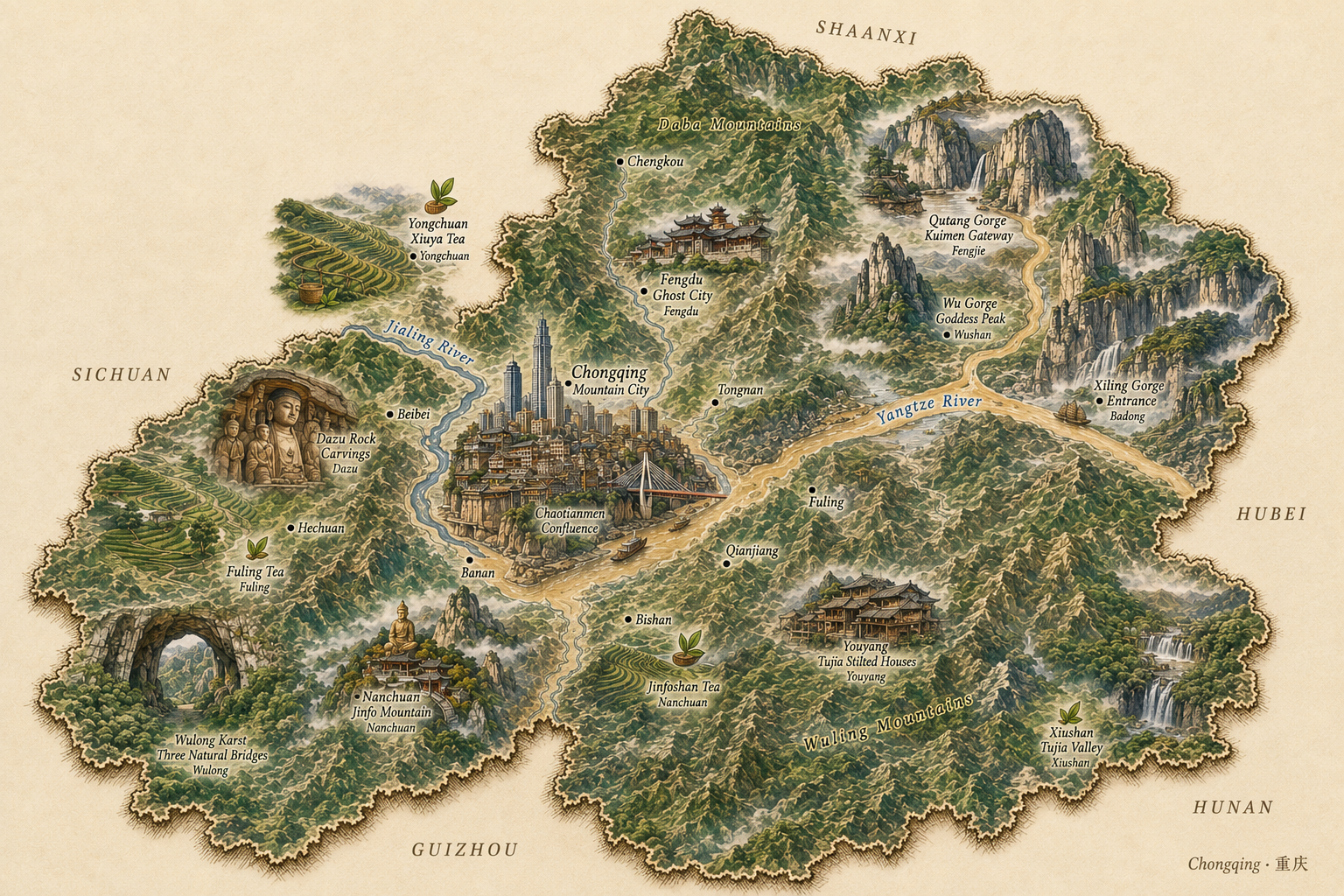
Chóngqìng · 重庆市
Trade route · Yangtze Gates · Tea-Horse Road · Sichuan Gaiwan

Chóngqìng

重庆市 · Chóngqìng

Where the Yangtze is born, caravans depart for Tibet

山城茶韵

Chongqing — a mountain metropolis at the confluence of the Yangtze and Jialing rivers, historically the gateway to the Tea-Horse Road. Sichuan brick tea from Ya'an was loaded here onto caravans heading for Tibet via Ganzi and Kangding. Chongqing's tea houses have a distinctive style: open terraces over the river, bamboo deck chairs, Sichuan gaiwan (盖碗). Route: historic Ciqikou with a 1000-year-old tea house → Yangtze cruise through the Three Gorges → Dazu Rock Carvings, a UNESCO site → Hongya Dong with hanging houses in the Bayu style.

Teas of this area

Сычуаньский гайвань 盖碗茶

Special tea ware of Sichuan and Chongqing: saucer + cup + lid. The lid holds back leaves while drinking, the saucer protects the hand from hot porcelain. In the tea houses of Chengdu and Chongqing, it is a symbol of the 'chat all day over a gaiwan' lifestyle.

Кирпичный Цзанча из Чунцина 藏茶砖

Sichuan dark tea for Tibet. Produced in Ya'an, pressed in Chongqing, from there it departed on caravans to Tibet. One brick could be exchanged for a fine horse. Coarse, earthy, warming — ideal for high altitudes.

Чай Башу 巴蜀茶

A regional category of Sichuan and Chongqing green teas. Chestnut aroma, sweet aftertaste. Comparatively little known outside Sichuan, but loved by locals as a daily tea.

Route by days

  1. Дни 1–2

    Цицикоу · Древняя чайная улица 磁器口古镇

    Tea Houses 1000 Years Old

    Ciqikou (磁器口古镇) — a 1000-year-old port village on the banks of the Jialing, once a stop on the tea-caravan route. Zhenzhui Tea House (镇丘茶馆) — an open terrace over the water, bamboo deck chairs, Sichuan gaiwan. Locals 'chat all day over a gaiwan' — a way of life. Tasting: comparing Sichuan gaiwan and Beijing zisha. Tea-Horse Road Caravan Museum.

    Guesthouse in old port style — bamboo, balconies

  2. День 3

    Хунъя Дун · Висячие дома 洪崖洞

    Bayu Style · Tea with a View

    Hongya Dong (洪崖洞) — a complex of hanging houses in the diaolou style of the Bayu era, 11 storeys, clinging to a cliff above the river. Tea house on the 7th floor — panoramic view of the Yangtze–Jialing confluence. Night illumination — like a scene from a Miyazaki anime. Tea session with Bashu mountain tea. Comparing Hongya Dong (stylization) versus authentic historic diaolou in Fujian.

    Boutique hotel in a skyscraper — view of Hongya Dong

  3. Дни 4–5

    Янцзы · Три Ущелья 长江·三峡

    Cruise Through the Giants

    Yangtze cruise through the Three Gorges (三峡): Qutang, Wuxia, Xiling. Hanging coffins of the ancient Ba people on the cliffs. Tea picnics on deck — mountain tea in a gaiwan with a gorge panorama. The Three Gorges Dam — the world's largest hydropower station. Tea history: before the dam was built (2003), the gorges were more dramatic. Literary associations with Li Bai and Du Fu.

    Yangtze cruise liner

  4. День 6

    Дацзу · Каменные резьбы 大足石刻

    UNESCO · Buddhist Mountains

    Dazu Rock Carvings (大足石刻) — UNESCO site, over 50,000 Buddhist statues on cliffs, 9th–13th centuries. The famous '1000-armed Guanyin' scene — 1007 gilded arms. Scenes of Buddhist hell, epics, daily life in the Song Dynasty. Tea house at Baoding Temple — meditative tea with monks. Comparing Dazu versus Leshan versus Yungang — the three great rock-carving sites of China.

    Guesthouse near Dazu

  5. День 7

    Чунцин · Хого · Финал 重庆·火锅

    Fiery Hotpot + Tea · Finale

    Chongqing — the world capital of hotpot (火锅, fire pot). The spiciest chilli with everything simmering in it. Tea house after hotpot — an obligatory ritual: oily hotpot + cold jasmine tea = perfect balance. Chongqing Hotpot Museum. Final tasting: gaiwan, zangcha, Bashu tea. Purchasing brick tea and Sichuan gaiwans. Ascent on the cable car over the Yangtze — a symbol of Chongqing.

Planning

Transport
Arrival at Jiangbei (CKG). Light metro climbs the mountains — a unique system. Yangtze cruise: Chongqing → Yichang 3–4 days. Cable car over the river — a must-do.
Climate
Subtropical monsoon. Summer: 30–40°C, very hot and humid (one of China's 4 'furnace cities'). Winter: 5–10°C, foggy. Optimal: October–April.
What to bring
Light clothing in summer + raincoat, comfortable shoes (mountain city — many stairs), pocket tissues (spicy food!), cash for local tea houses.
Buying tea
Ciqikou — the best choice. Brick Zangcha: from 80 ¥. Sichuan gaiwan set: from 150 ¥. Bashu tea: from 100 ¥ per jin. Sichuan pepper and chilli — culinary souvenirs.