Shānxī · 山西省
Trade route · Jin Merchants · Great Tea Route · 4 UNESCO · Pingyao

Shānxī

山西省 · Shānxī

Where Jin merchants built banks, tea caravans rolled toward Kyakhta

晋商茶路

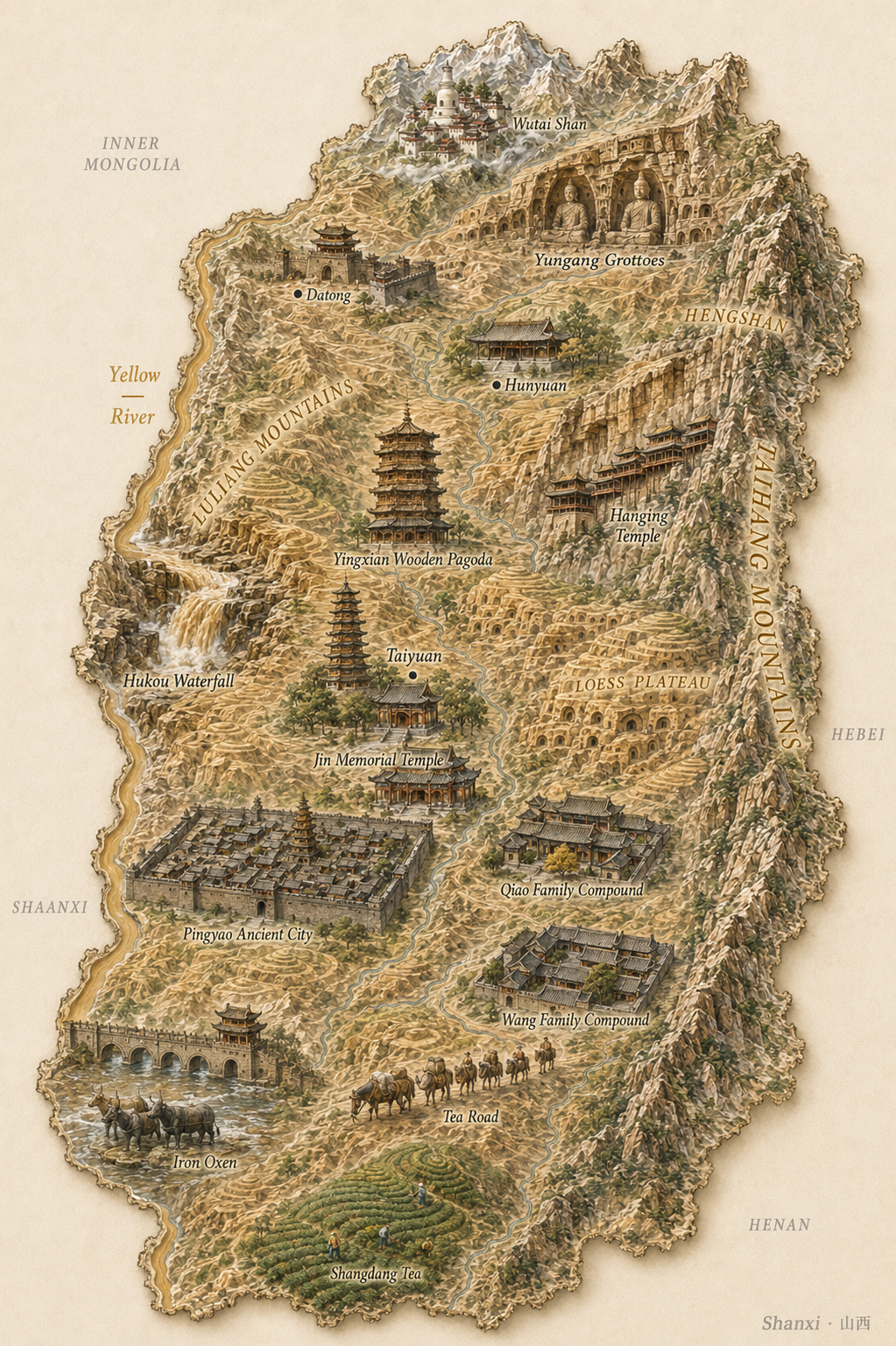
Shanxi is the homeland of the Jin merchants (晋商), who for 200 years (17th–19th centuries) controlled the Great Tea Route from the Wuyi plantations to Russian Kyakhta, spanning 11,000 km. The financial capital of Pingyao, with its network of piaohao (banks), serviced this trade. Shanxi is also rich in UNESCO heritage: the sacred Mount Wutai, the Yungang Grottoes, the ancient city of Pingyao, and the Xuankong Hanging Temple. Itinerary: Pingyao with banks → Qiao Family Compound → Wutai Shan → Yungang in Datong → Xuankong Si → Hukou Waterfall on the Yellow River.

Teas of this area

Цзинь-чайный путь 晋商茶路

Shanxi merchants established the Great Tea Route in the 17th century. The route: Fujian (Wuyi) → Hubei → Shanxi → Inner Mongolia → Kyakhta (Russian border) → Moscow. 11,000 km, 16 months one way. Pingyao became the banking capital of this trade — caravans were financed here.

Прессованный чай Цзинь-купцов 晋商砖茶

Jin merchants bought up green teas from Wuyi and Hubei, brought them to Shanxi, where they were pressed into bricks for Russian export. Yuanchun, Qishengchuan, Dashengkui — renowned trading houses. Today — a historical reconstruction in museums.

Местный шаньсийский чай 山西本地茶

Daizhou (代州) and Guangling — local small-scale tea gardens in the mountains of Shanxi. Green tea in the provincial style — chestnut aroma, traditional tea drinking in the courtyards of grey-brick architecture.

Route by days

  1. Дни 1–2

    Пинъяо · Банковская столица 平遥古城·日升昌

    UNESCO · Financial Wall Street of the Qing

    Pingyao (平遥古城) — UNESCO, the best-preserved old city in China, 4th century BC. The 6 km city wall is completely intact. Rishengchang (日升昌) — China's first bank (piaohao), founded in 1823. It financed the tea caravans of the Jin merchants. Rishengchang Museum: silver ingots, banknotes, contracts, Tea Route maps. Reconstruction of the piaohao's role: a merchant deposited silver in Pingyao, received a receipt, the caravan reached Kyakhta, where the receipt was exchanged for silver. 100 piaohao operated across China.

    Hotel in a traditional Pingyao courtyard
  2. День 3

    Дом семьи Цяо 乔家大院

    Merchant Mansion

    Qiaojia Dayuan (乔家大院) — the mansion of the Qiao family, the largest Jin merchants of the 19th century. 313 rooms, 6 courtyards, a classic example of a Shanxi merchant dwelling. Zhang Yimou's film 'Raise the Red Lantern' was filmed here. The Qiao family tea house — Shang Ke Tang (商客堂) — a reconstruction of a reception for Russian merchants. Tasting: Wuyi tea in the Qing style — bricks, pressing, packaging for a long journey. Comparison of the Qiao vs. Wang houses (王家大院, even larger).

    Pingyao guesthouse

  3. День 4

    Утайшань · Буддистская гора 五台山

    UNESCO · 1 of the 4 Sacred Mountains

    Wutai Shan (五台山) — UNESCO, one of the four sacred mountains of Chinese Buddhism (Manjushri Bodhisattva). 53 monasteries, 3,061 m. Pusa Ding Tibetan Monastery — Dalai Lamas reside here during their travels. Tea session with monks at Xiantong Monastery (显通寺): Tibetan-style po cha, Chinese Longjing for Shaolin monks, a meditative ritual. Comparison with the other three sacred Buddhist mountains.

    Monastery guesthouse — the sound of prayers at dawn

  4. День 5

    Датун · Юньган 云冈石窟

    UNESCO · Colossal Buddhas

    Yungang (云冈石窟) — UNESCO, Buddhist caves of the Northern Wei dynasty, 5th–6th centuries. 252 caves, 51,000 statues, the largest Buddha 17 m. Gandharan and Indian influence — a junction of the Silk Road with Chinese sculptural art. Tea session in the cave complex at sunset. The historical role of Datong as a military capital and a trading hub between the steppe and the Central Kingdom.

    Datong hotel

  5. День 6

    Сюанькун Сы · Иньсянь Пагода 悬空寺·应县木塔

    Hanging Temple · Wooden Pagoda

    Xuankong Si (悬空寺) — the Hanging Temple of the Northern Wei dynasty, 5th century, attached to a sheer cliff 75 m above the ground. A unique synthesis of Daoism, Buddhism, and Confucianism in a single temple. Yingxian Mu Ta (应县木塔) — a wooden pagoda from 1056, 67 m high, without a single nail, the oldest wooden pagoda in the world. Tea session on the observation deck of Xuankong Si — breathtaking views.

    Hongyuan guesthouse

  6. День 7

    Хукоу · Жёлтая Река · Финал 壶口瀑布·黄河

    Yellow River Waterfall · Finale

    Hukou (壶口瀑布) — the only waterfall on the Yellow River, 50 m wide, 30 m high. The Yellow River is a symbol of Chinese civilization — culture was born here. The water colour is a vivid ochre (as on the maps of the Tea Path series!). Final tea session: the evolution of Jin merchants from the 17th century to their collapse in the 1930s, the legacy of the Great Tea Route in modern trade. Purchase of Pingyao tea and calligraphy.

Planning

Transport
Arrival at Taiyuan (TYN) or Datong (DAT). High-speed train Taiyuan–Pingyao in 30 min. Minibus between points. Roads through the mountains of Shanxi — winding but beautiful.
Climate
Continental, continental. Summer: 22–30°C, dry. Winter: -10°C, little snow. Spring and autumn are the best times. Wutai Shan — at 3,061 m, it is always cool.
What to bring
Comfortable shoes (many steps!), a warm layer for Wutai Shan, SPF, a thermos for tea, cash, a camera (4 UNESCO sites in a row!).
Buying tea
Museum tea bricks of the Jin merchants: from 100 ¥. Shanxi vinegar (famous throughout China) — a culinary souvenir. Pingyao delicacies: beef, tofu. Silver ingot souvenirs. Wutai Shan calligraphy.