Хусиньтин чай 湖心亭茶
Historic teahouse in Yuyuan Garden (1855), on an island in Yu Lake. Shanghai’s oldest operating teahouse. They serve Longjing green tea in ceramic gaiwans. Qing-era contracts were signed here and secret societies met.
上海市 · Shànghǎi
Clippers departed from the Bund — and tea conquered the world
外滩茶云
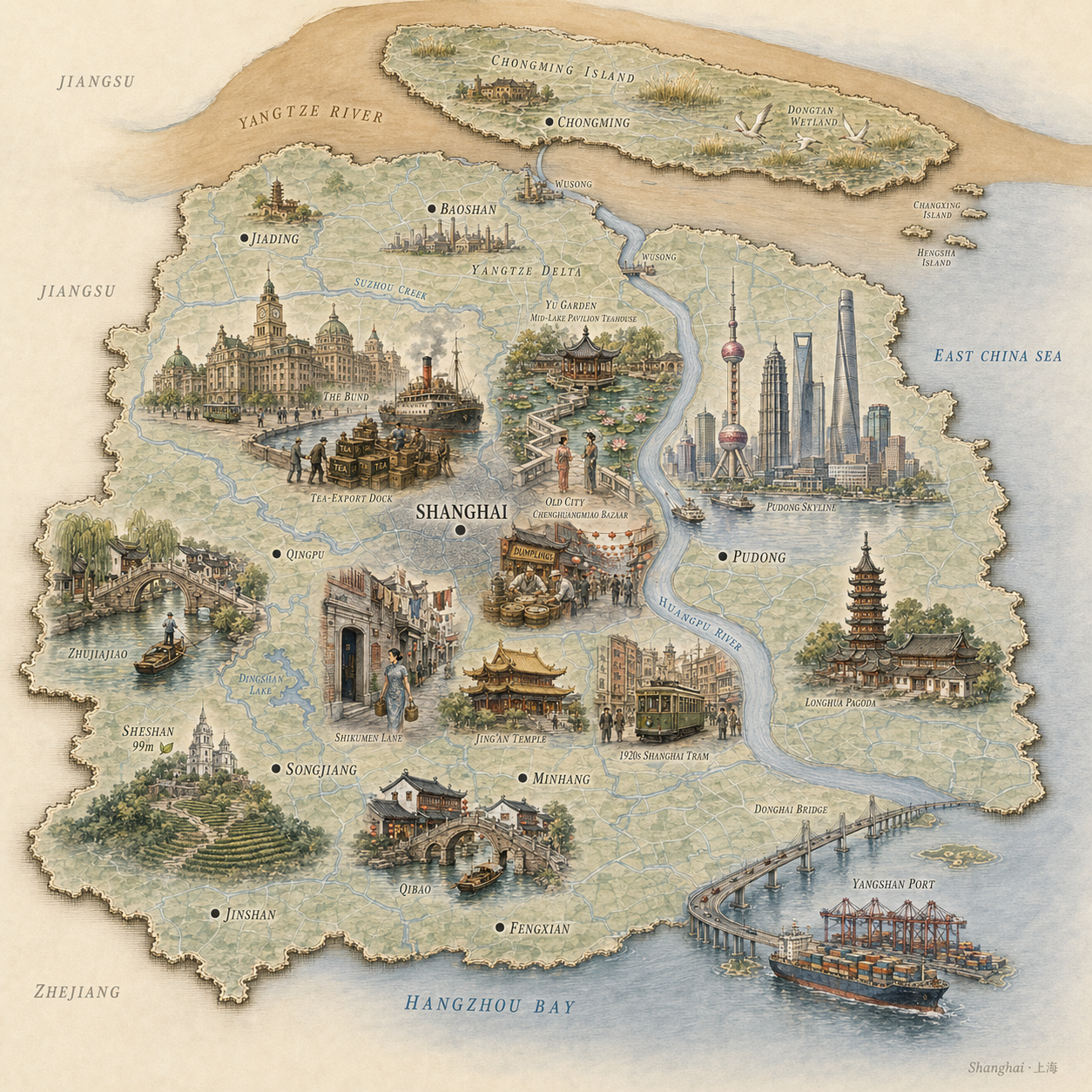
Shanghai — the cosmopolitan maritime terminal of the Tea Route. During the concession era (1842–1943), British, French, and American traders turned the Bund into Asia’s largest tea export hub. The famous 'Great Tea Clipper Race' of 1866 — Ariel and Taeping sailed from Fuzhou to London in 99 days with a cargo of new tea. Route: the historic Bund → Yuyuan Garden with its Huxinting tea pavilion → former tea warehouses on Suzhou Creek → the French Concession → the tea museum in Jiading → Shanghai Tower and the Pudong skyscrapers.
Historic teahouse in Yuyuan Garden (1855), on an island in Yu Lake. Shanghai’s oldest operating teahouse. They serve Longjing green tea in ceramic gaiwans. Qing-era contracts were signed here and secret societies met.
In the 19th century, 80% of Chinese tea bound for Europe and America passed through Shanghai. The famous clippers Cutty Sark, Ariel, Taeping loaded at the Bund. Tea brokers (compradors) — Chinese intermediaries — made fortunes from this trade.
Shanghai is an incubator of a new Chinese tea culture. Brands like Heytea, Nayuki, Lelecha transformed traditional teas into designer drinks. Bubble tea, fruit teas, cheesecake tea — here they reinvented tea for millennials.
Colonial Heritage
The Bund (外滩) — 1.5 km of colonial architecture on the banks of the Huangpu. Building No. 3 (the former Union Building) — the main tea brokerage centre of the 19th century. Building No. 12 (the former HSBC) — financed the tea trade. The Bund Museum — 'The Era of Tea and Opium' exhibition. In the evening — a Huangpu cruise: the lights of Pudong and the Bund illuminations. The Astor House Hotel tea room — China’s first European hotel (1846).
Colonial hotel on the Bund — high ceilings, English style
Shanghai’s Oldest Teahouse
Yuyuan Garden (豫园) — a classical Chinese garden from the Ming era, 1577. Huxinting Teahouse (湖心亭) — on an island in the middle of a lake, accessible only by a zigzag bridge (to ward off evil spirits). Here, Bill Clinton and Queen Elizabeth II drank tea. Tasting: Longjing from the Dragon Well. A walk through the Old Town: alleys, shops, the night market.
Boutique hotel in the Old Town — wooden balconies
Former Tea Warehouses
Suzhou Creek (苏州河) — a tributary of the Huangpu, along which tea junks entered Shanghai from Zhejiang. Former tea warehouses (the M50 district) — now an art cluster. The Junk Museum at Shanghai Capital — 'Tea Junks from Hangzhou' exhibition. A comparison: historic clippers vs modern container ships at Yangshan Port.
Loft hotel in a former warehouse — brick and beams
Plane-Tree Streets · Tea Cafés
The French Concession (法租界) — the Wukang Road area with plane trees and mulberry-hued 1920s mansions. European-style tea houses. Heishan Lu — a street of boutiques and art galleries. Tea tasting at Tang Court or Mi Xun Teahouse: a fusion of Western design and Chinese tea tradition. Former French tea brokers on Joffre Road.
Boutique hotel in a 1920s mansion
Museum of Chinese Tea
Jiading (嘉定) — a northern suburb of Shanghai. The Museum of Chinese Tea (中国茶文化博物馆) — the most complete collection of tea culture in China. The evolution of tea ceremonies from the Tang dynasty to the present day. A reconstruction of tea houses from different eras. The 'Tea and Western Trade' exhibition — clippers, contracts, photographs of the 19th-century Bund.
Modern hotel in Jiading
Modernity · Finale
Pudong — the symbol of the new Shanghai. Shanghai Tower (632 m) — the second tallest in the world, observation deck on the 118th floor. A tea salon on the top floor — Chinese tea with a view of the Bund below. A final tasting: the evolution from historic Huxinting to modern Heytea. Bubble tea on Nanjing Road. Shopping on the Chenghuang Miao tea street.