По ча Кумбума 塔尔寺酥油茶
Butter tea of Ta'er Monastery (塔尔寺) — one of the six great monasteries of the Gelug school. Thousands of monks drink po cha with yak butter daily. Served to pilgrims in the refectory.
青海省 · Qīnghǎi
Where the Yellow River is born, tea becomes sacred
高原茶韵
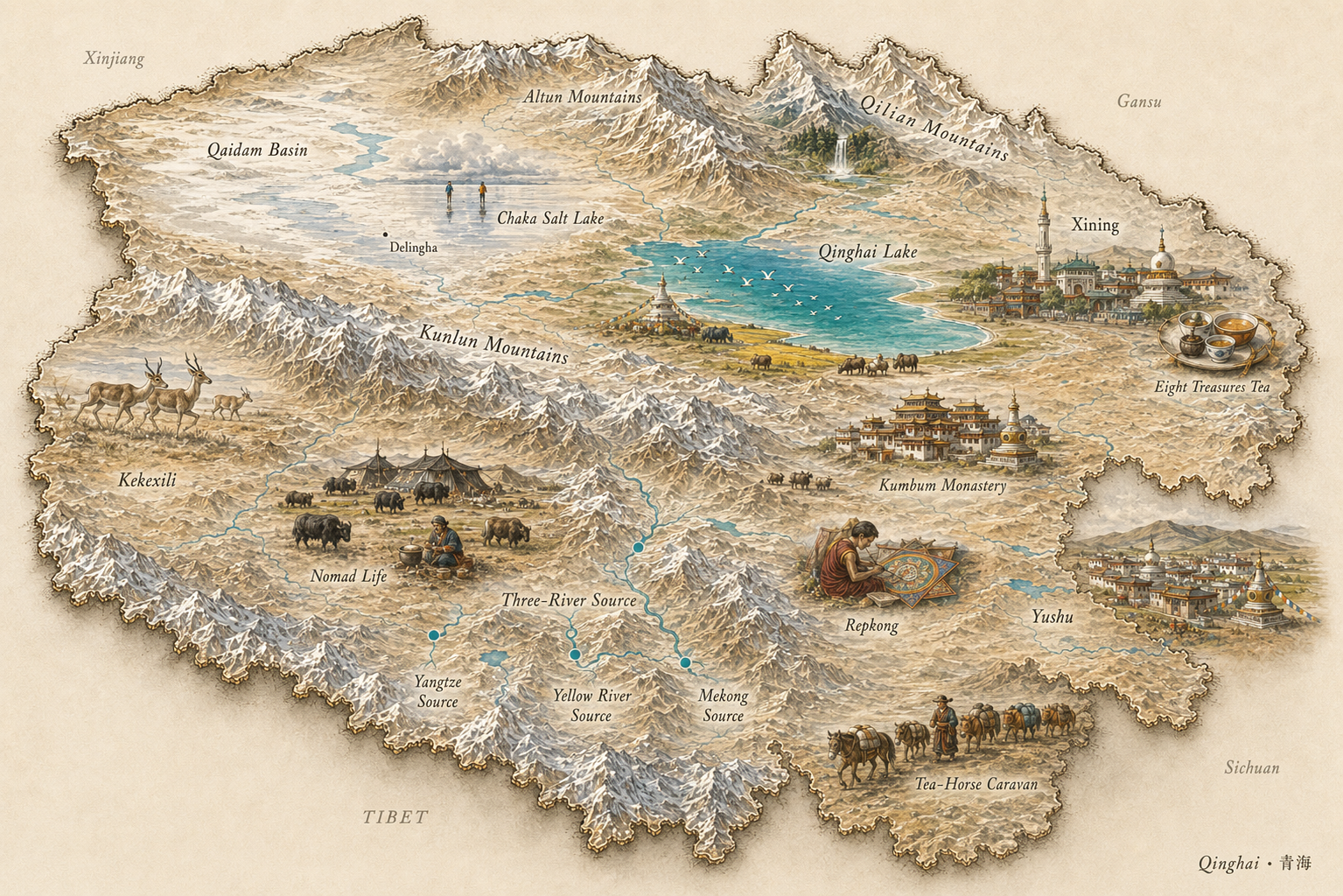
Qinghai is a high-altitude province at the crossroads of Tibetan, Mongol, and Hui tea worlds. Through Qinghai, caravans with Tibetan tea from Sichuan and Yunnan made their way to Tibet. Tibetan po cha, Mongol süütei tsai, and Hui sanpaotai meet in the same markets. Route: the turquoise Qinghai Lake (China's largest salt lake) → Ta'er Monastery (birthplace of Tsongkhapa) → the source of the Yellow River → Chaka Salt Terraces → Kumbum tea in monasteries.
Butter tea of Ta'er Monastery (塔尔寺) — one of the six great monasteries of the Gelug school. Thousands of monks drink po cha with yak butter daily. Served to pilgrims in the refectory.
Hui-Muslim eight-treasure tea. Xining — the capital of Qinghai with a large Hui community. Tea houses in mosque style — with domes and arabesques.
The Qinghai route of the Tea-Horse Road is less known than the Sichuan one, but no less important. Through Yushu and Yushu, caravans went from Chamdo to Lhasa, laden with Sichuan Tibetan tea in exchange for Tibetan horses.
Plateau Capital · Kumbum
Xining (西宁) — capital of Qinghai, 2261 m. Dongguan (东关) — the great mosque, center of the Hui community. Tasting sanpaotai in Hui restaurants with noodles. Ta'er Monastery (塔尔寺, Kumbum) — birthplace of Tsongkhapa, founder of the Gelug school. Three great treasures: butter sculptures of tsampa, frescoes, bas-reliefs. Po cha with monks in the refectory — a meditative session.
Hotel by Ta'er Si — sounds of prayer trumpets
The Largest Salt Lake
Qinghai Lake (青海湖) — China's largest salt lake, 4300 km², 3196 m. Sacred in Tibetan Buddhism. Bird Island — swans, geese, cormorants. Yellow bloom of rapeseed fields in June–July — the main photogenic season. Tea picnic on the shore with a Tibetan family — po cha and smoked meat. Comparing Tibetan po cha of Qinghai and Tibet — regional differences in salt and butter.
Yurt on the shore — stars over turquoise
"Mirror of the Sky"
Chaka (茶卡盐湖) — "Mirror of the Sky", a salt plateau lake at 3059 m. The perfectly smooth salt surface reflects the clouds — the most famous photo spot of the Northwest. Salt has been mined here for 3000+ years — since the Han dynasty. A salt narrow-gauge railway takes tourists across the lake. Tea with salt — traditionally locals drink tea with a pinch of Chaka salt, adding minerality.
Chaka guesthouse
Sources of the Yellow River
Yushu (玉树) — Tibetan autonomous prefecture at 3600 m. Sources of the Yellow River (黄河源) — a sacred place where the Yellow River begins from melting glaciers. The ancient caravan route from Chamdo through Yushu to Lhasa. Tibetan nomadic tea session — po cha in a tent among yaks, with tsampa and dried cheese. Final tea ceremony: Tibetan, Mongol, Hui, Chinese tea — all four traditions on one table.
Tibetan guesthouse — nomadic authenticity