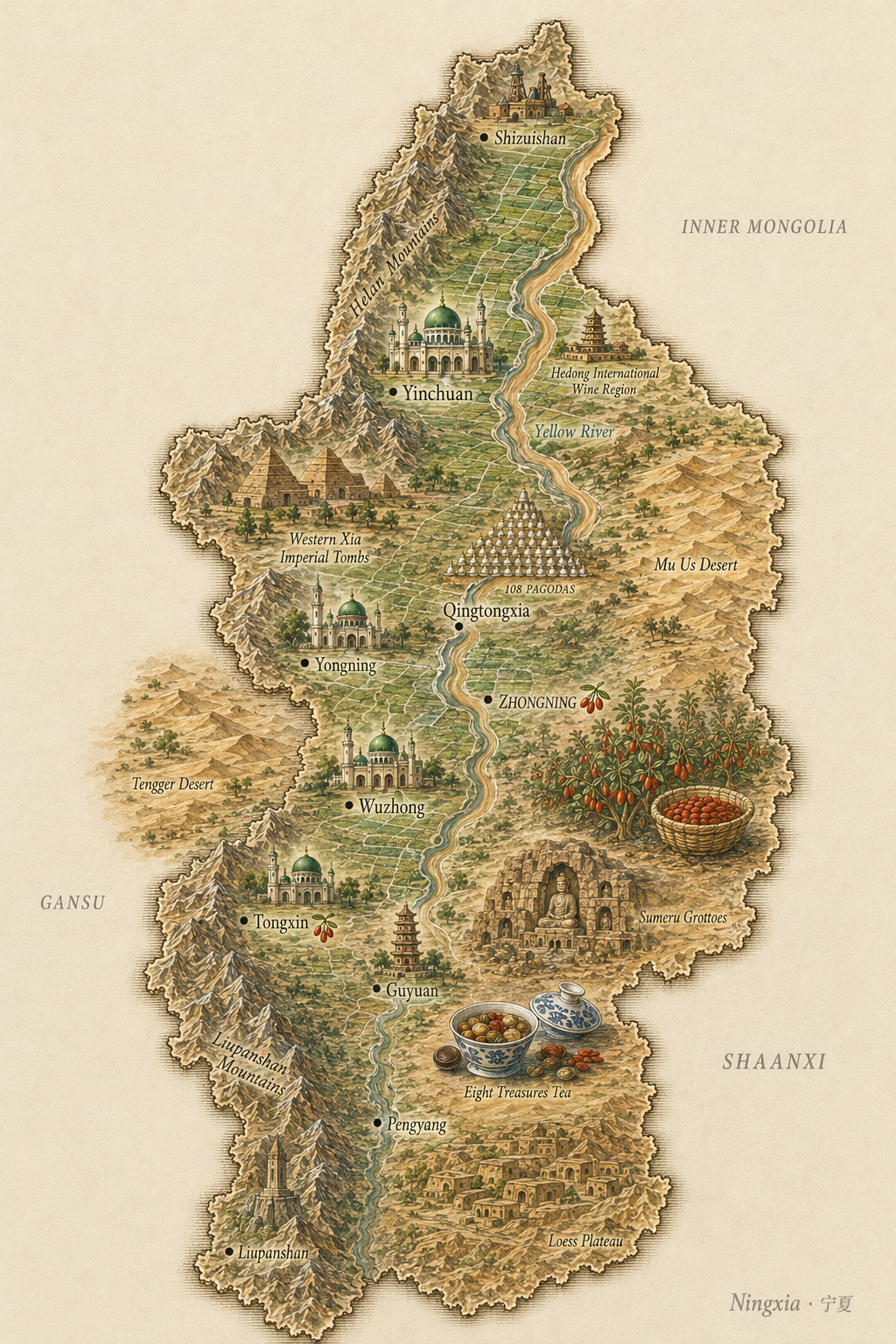
Níngxià · 宁夏回族自治区
Trade route · Hui Capital · Eight Treasures · Goji · Yellow River

Níngxià

宁夏回族自治区 · Níngxià

Where the Yellow River becomes an oasis, tea is drunk with eight treasures

回族八宝茶

Ningxia is the heart of Hui Muslim tea culture, a 'sleeve' province at the bend of the Yellow River. Here, ba bao cha (八宝茶) — eight-treasure tea — is born: green tea + goji berries + red dates + rock sugar + chrysanthemum + walnut + raisins + jujube paste. Served in a lidded gaiwan, a symbol of ritual hospitality. Route: Yinchuan with the Grand Mosque → Western Xia Imperial Tombs → Helanshan with petroglyphs → 108 Pagodas of Qingtongxia → Xumishan Grottoes. Ningxia goji is the finest in the world.

Teas of this area

Ба бао ча (Восемь сокровищ) 八宝茶

Hui ritual tea: 8 ingredients in a lidded gaiwan. Green tea + Ningxia goji + red dates + rock sugar + dried chrysanthemum + walnut + raisins + crushed jujube paste. Served to the guest — three cups (the minimum of politeness). Sweet, aromatic, warming, a symbol of Ningxia.

Годжи (волчья ягода) 枸杞

Ningxia produces 50% of the world's goji. The most valued variety — Zhongning (中宁) on the banks of the Yellow River. Dried berries are added to ba bao cha or brewed separately — a ruby-coloured infusion, sweet, regarded as an 'elixir of youth' in traditional medicine.

Хуэйский гайвань ритуал 盖碗仪式

Hui peculiarity: the gaiwan is lifted with both hands — left for the saucer, right for the lid used as a 'spout' for careful drinking. Before a sip, the lid is drawn across the surface to push aside the leaves and inhale the aroma. Social code: the guest does not drink until invited by the host.

Route by days

  1. Дни 1–2

    Иньчуан · Большая мечеть 银川·南关清真大寺

    Hui Capital · Ba Bao Cha

    Yinchuan (银川) — the capital of Ningxia, a synthesis of Chinese and Islamic cultures. Nanguan — the Grand Mosque with three green domes, a UNESCO candidate. Hui tea rituals — a ba bao cha masterclass in a local Hui family home. Comparison: Hui ba bao cha versus Gansu sanpaotai — two versions of the 'eight treasures'. Cuisine: lagman, baursak, shashlik.

    Hui guesthouse — white walls, blue doors, inner courtyard

  2. День 3

    Имперские гробницы Си Ся 西夏王陵

    'Eastern Pyramids'

    Western Xia Imperial Tombs (西夏王陵) — the necropolis of the Tangut kingdom, 9th–13th centuries. 9 main tombs + 254 minor ones over 50 km². Conical earthen pyramids — the 'Eastern Pyramids'. The Tangut script is lost, known only from the tombs. Western Xia Museum: tea rituals of the Tangut court, frescoes of tea scenes. Tea meditation among the ruins at sunset.

    Boutique hotel in Yinchuan

  3. День 4

    Хеланьшань · Петроглифы 贺兰山岩画

    Ancient Rock Carvings

    Helanshan (贺兰山) — a mountain range separating the desert from the Yellow River valley. Helankou petroglyphs: 6000+ rock carvings up to 10,000 years old — hunters, shamans, totems. An 'Encyclopedia of the Northwest in stone'. Tea session with locals at the mountain foot, goji tea straight from the bush. Comparison of Helanshan petroglyphs with Yinishan ones (Inner Mongolia) — the two main collections of the Northwest.

    Helankou guesthouse

  4. День 5

    108 Пагод Циньтунся 青铜峡·一百零八塔

    Unique Buddhist Ensemble

    108 Pagodas of Qingtongxia (一百零八塔) — China's sole ensemble of 108 Buddhist stupas, arranged in a triangle on a hillside by the Yellow River. Yuan dynasty, 14th century. The number 108 is sacred in Buddhism (the number of desires to be overcome). Tibetan-Mongolian influence in the architecture. Tea session in the temple complex with monks.

    Yellow River guesthouse

  5. День 6

    Сюмишань · Пещеры 须弥山石窟

    'Mount Sumeru'

    Xumishan (须弥山石窟) — Buddhist caves of the Northern Wei dynasty, 5th–9th centuries. 132 caves, over 350 statues. 'Mount Sumeru' — the sacred mountain in Buddhist cosmology. A giant seated Buddha statue (20.6 m). Tangut and Mongolian inscriptions. Tea picnic with a panorama of the Tengger Desert.

    Hui guesthouse in Guyuan

  6. День 7

    Чжунин · Годжи · Финал 中宁·枸杞

    Goji Capital · Finale

    Zhongning (中宁) — the goji capital of Ningxia, the finest in the world. 50,000 hectares of plantations on the banks of the Yellow River. Goji harvest (July–September) — done by hand; a gentle flick drops the berry into the basket. Tasting: fresh goji versus dried versus tea. Final ba bao cha session with local masters. Purchase of goji and Hui tea kits.

Planning

Transport
Arrival at Yinchuan (INC). Buses and minibuses for internal travel. A small, compact province — all points within 2–3 hours' drive from Yinchuan. High-speed train from Xi'an takes 6 hours.
Climate
Continental, semi-desert. Summer: 22–32°C, dry. Winter: -15 to +5°C. Spring and autumn are the best seasons. Sandstorms in spring. High UV.
What to bring
Light clothing + windbreaker, comfortable footwear, SPF50+, headgear, a thermos for tea, cash, respect for Muslim customs (alcohol not available everywhere, no pork, Friday is a prayer day).
Buying tea
Ba bao cha kits (all-in-box): from 80 ¥. Zhongning goji: from 200 ¥/kg (premium A++). Hui gaiwans: from 100 ¥. Tangut ceramic souvenirs. Helanshan stones for calligraphy.