Маньчжурский молочный чай 满族奶茶
Manchurian milk tea tradition, akin to Mongolian süütei tsai, but with different proportions: more butter, less salt. In the Mukden Palace of the Qing emperors — a special court ritual, distinct from Han tea drinking.
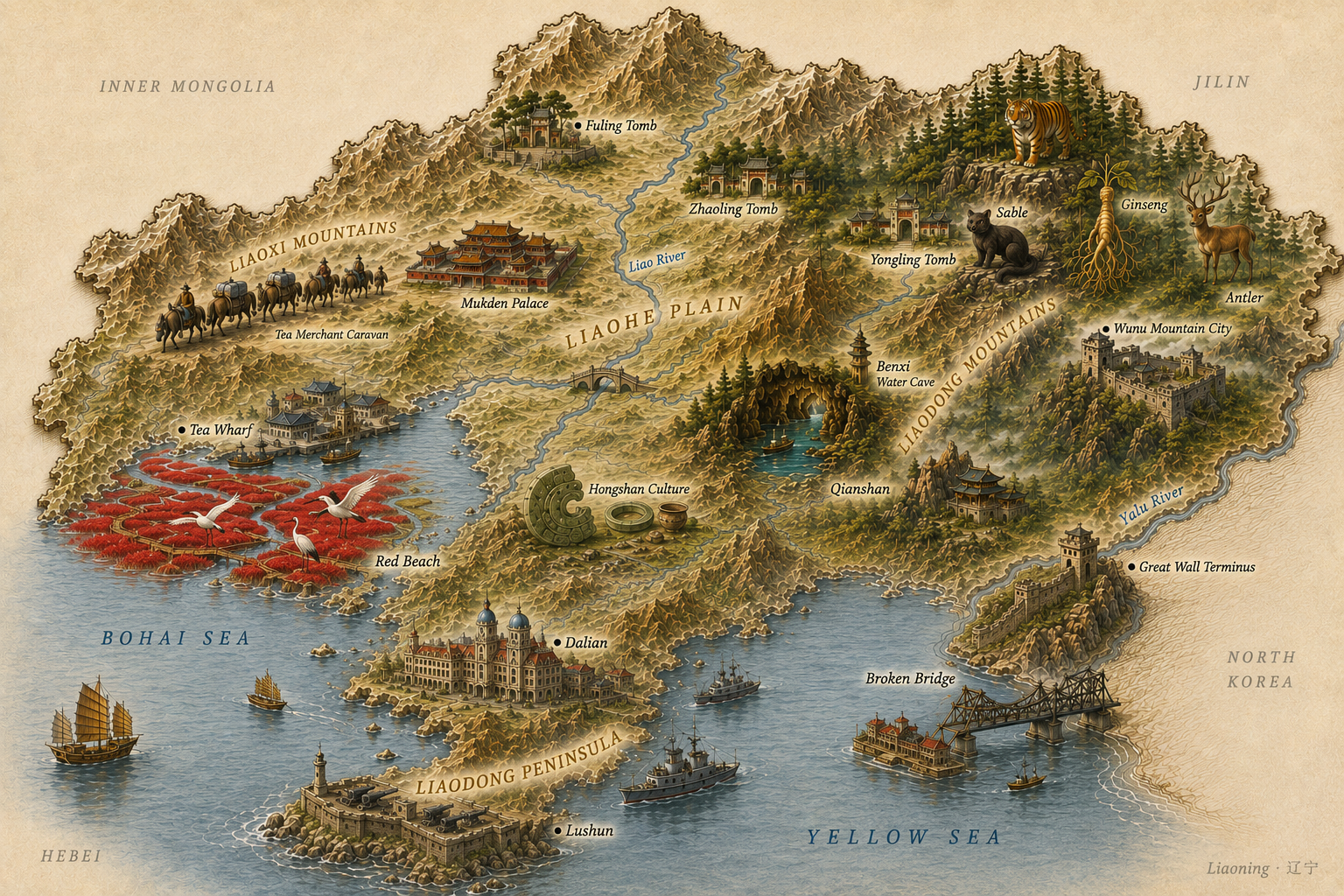
辽宁省 · Liáoníng
Where the Manchus became emperors, tea caravans found their way to the East
辽地茶情
Liaoning — the Manchurian homeland, a loop of the Great Tea Route through the northeast. Here, Manchu merchants took tea from Shanxi-merchants and forwarded it further east — to Korea, Japan, and across the Amur to the Russian border. Shenyang's Mukden — the first capital of the Qing, where the Manchus mastered Chinese tea culture. Route: Mukden UNESCO → three Qing tombs → Yalu (Broken Bridge on the Korean border) → Qian Shan thousand peaks → Benxi cave → Panjin Red Beach → Hushan Great Wall Terminus → Goguryeo city of Wunu Shan → colonial Dalian and Lüshun (Port Arthur).
Manchurian milk tea tradition, akin to Mongolian süütei tsai, but with different proportions: more butter, less salt. In the Mukden Palace of the Qing emperors — a special court ritual, distinct from Han tea drinking.
Tea for the Manchu Banner Army: coarse pressed tea for long campaigns. Stored in leather sacks, brewed in cauldrons under field conditions. Today — a historical reconstruction.
Not tea, but complementary: ginseng, sable fur, deer antlers. A tea session with ginseng (人参茶) — a traditional tonic, especially popular in Changbai Shan.
First Qing Capital · UNESCO
Shenyang (沈阳) — the capital of Liaoning, formerly Mukden (盛京), the first capital of the Qing dynasty (1625–1644). Mukden Palace (沈阳故宫) — UNESCO, a miniature Forbidden City with the stylistics of Manchu yurts. Tea ceremonies of the Manchu emperors — a reconstruction of the court ritual. North Pagoda (北塔) and East Pagoda. Tasting: Manchu milk tea vs. Han green tea — the difference in the styles of conquerors and the conquered.
Boutique hotel in Manchu style
Three Imperial UNESCO Tombs
Fuling (福陵) — the tomb of Nurhaci, founder of the Qing dynasty. Zhaoling (昭陵) — the tomb of Hong Taiji. Yongling (永陵, in Xinbin) — the tomb of the ancestors. All three — UNESCO. Tea burial rites: tribute tea as part of imperial sacrifices. Comparing Manchu tombs in Shenyang vs. Qing tombs in Hebei — two stages of the dynasty (homeland and empire).
Shenyang guesthouse
Korean Border · Broken Bridge
Dandong (丹东) on the Yalu River (鸭绿江) — a border city with the DPRK. Broken Bridge (鸭绿江断桥) — a bridge bombed by the Americans in 1950 during the Korean War. Half of the bridge stands in North Korea, half in China. A tea session on the bridge with a view of the DPRK — a special feeling. The Hushan Great Wall Terminus (虎山长城) — the eastern end of the Wall. North Korea can be seen through binoculars.
Hotel on the Yalu River
Underground River · Scarlet Landscape
Benxi (本溪) — Benxi Water Cave (本溪水洞), a 5 km underground river, the largest in Asia. A boat excursion through glowing caves. Qian Shan (千山, 'Thousand Mountains') — a Daoist complex over 1500 years old. Panjin Red Beach (盘锦红海滩) — scarlet fields of Suaeda salsa, the brightest red landscape in the world. A tea picnic on wooden boardwalks amid a red sea with white cranes.
Panjin guesthouse
Korean Empire · Neolithic Culture
Wunu Shan (五女山) — the fortress city of Goguryeo (37 BC), the first capital of the Korean empire, UNESCO. The oldest fortress in Northeast China. Hongshan (红山) — the site of discoveries of the Neolithic Hongshan culture (4500–3000 BC) — jade dragons, considered the prototype of the Chinese dragon.
Huanchen guesthouse
Colonial Port · Finale
Dalian (大连) — the largest port in Northeast China, Russian and Japanese colonization in the 20th century. Zhongshan Square — a Russian quarter with architecture from the 1900s. Lüshun (旅顺) — former Port Arthur, the site of the Russo-Japanese War of 1904-05. Japanese colonial buildings. Final tea session: Manchu milk + Chinese Longjing + Russian samovar = three empires of the Northeast. Purchasing ginseng and Manchu souvenirs.