Nèi Měnggǔ · 内蒙古自治区
Trade route · The Great Tea Road · Süütei Tsai · Brick Tea · Yurt

Nèi Měnggǔ

内蒙古自治区 · Nèi Měnggǔ

Where the clatter of hooves blends with the hum of the samovar

草原茶路

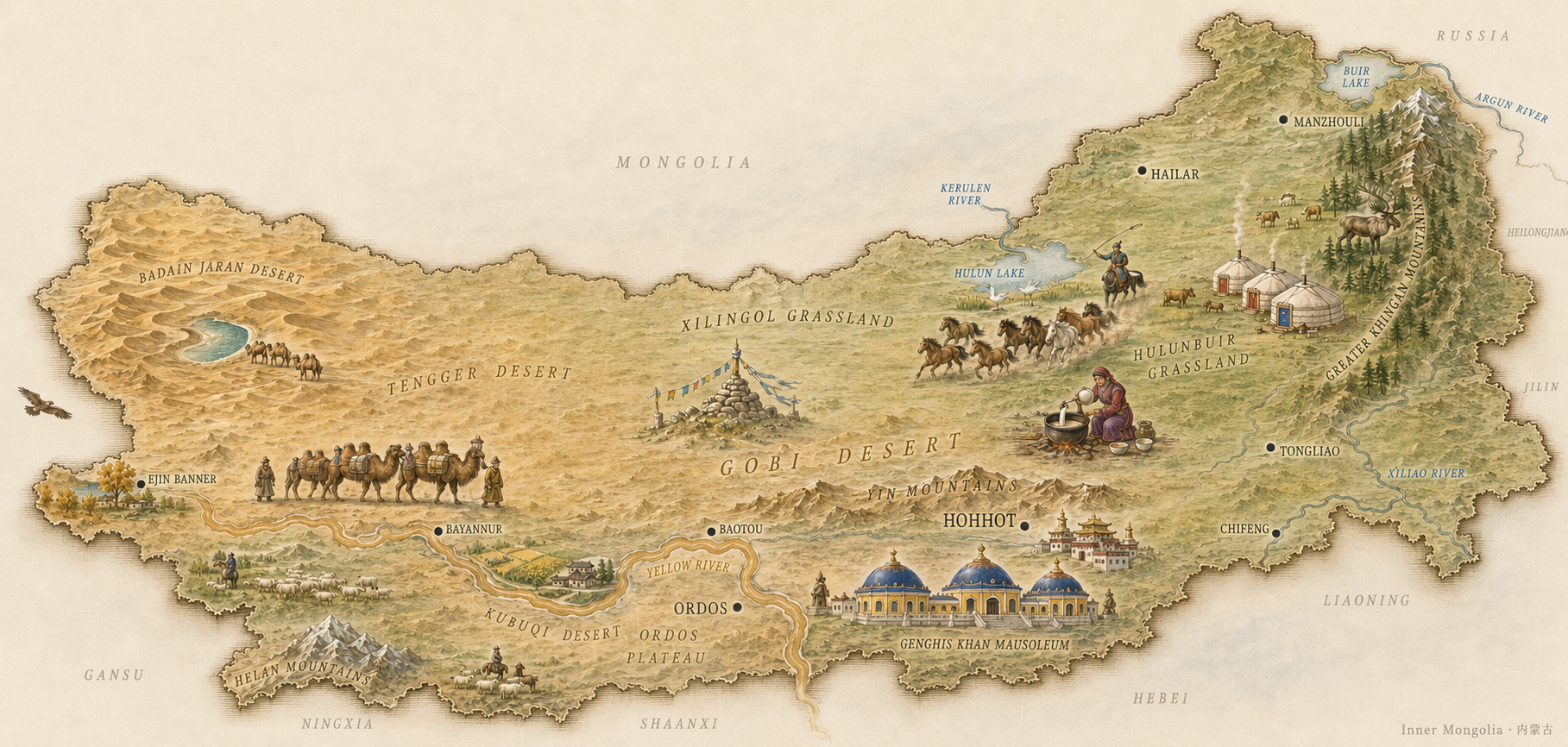
Inner Mongolia is the grassy corridor of the Great Tea Road, along which Shanxi merchants for two centuries shipped Wuyi tea to Russia via the border town of Kyakhta. On the steppe, tea served as currency: one brick = one sheep. Here, süütei tsai (奶茶) is born — Mongolian milk tea with salt and millet, the foundation of the nomadic diet. The route: Hohhot with the Mausoleum of Genghis Khan → the Kubuqi Desert → the boundless Hulunbuir grasslands → the border town of Manzhouli, where for 200 years caravans loaded tea into Russian samovars.

Teas of this area

Сутэй цай (молочный чай) 蒙古奶茶

Mongolian milk tea: brick tea + milk (mare's or cow's) + salt + butter + toasted millet. Boiled in a cauldron. Served with boortsog (fried doughnuts) and aaruul (dried curd). Not a single day in a yurt begins without süütei tsai.

Кирпичный чай Цинчжуань 青砖茶

Green brick heicha from Chibi (Hubei), specially produced for the steppe peoples. Pressed into bricks weighing 1.5–2 kg, it withstood transport across the Gobi. One brick = one sheep in barter trade.

Чай ламы 喇嘛茶

Milk tea of the Tibetan Buddhist tradition in the monasteries of Inner Mongolia. Without butter, with clove and cardamom. Served to lamas and pilgrims in ritual bronze bowls.

Route by days

  1. Дни 1–2

    Хух-Хото · Чингисхан 呼和浩特·成吉思汗陵

    Capital of the Steppe · Süütei Tsai

    Hohhot (呼和浩特, 'Green City') — the capital of the autonomous region. The Inner Mongolia Museum — exhibition 'The Tea Road Across the Steppe', maps of caravan routes from Shanxi to Kyakhta. The Mausoleum of Genghis Khan (成吉思汗陵) in Ordos — 1.5 hours away. A tasting of süütei tsai in a Mongolian restaurant: with boortsog, smoked meat, and aaruul. The old Lamaist temple Dazhao Si (大召寺) was founded in 1580.

    A boutique hotel in Mongolian style — felt hats, cashmere, carpets
  2. День 3

    Куобучи · Резеноут 库布齐沙漠·响沙湾

    Desert · Singing Sands

    Kubuqi (库布齐沙漠) — China's seventh-largest desert. Resonant Sand Bay (响沙湾, 'Singing Sands') — dunes up to 110 m high emit a 'song' when sliding. A tea picnic on a dune at sunset: süütei tsai in a samovar, camel milk. A camel caravan — a symbol of the Great Tea Road through the Gobi sands.

    A tent camp in the desert — starry sky, the singing of the sands

  3. Дни 4–5

    Хайлар · Хулунбуир 海拉尔·呼伦贝尔大草原

    Boundless Steppes · Yurts

    Hulunbuir (呼伦贝尔大草原) — China's largest pastoral region, comparable in size to Great Britain. Yurts of ethnic Mongols — traditional hospitality: three cups of süütei tsai (the minimum of politeness), mutton, dairy products. Lake Hulun — the 'Sea of Grass'. Herds of over 10,000 sheep. Horse racing and Bökh wrestling. A comparison: Mongolian süütei tsai versus Tibetan po cha (butter versus salt).

    An authentic herdsman family's yurt — felt, carpets, hearth

  4. День 6

    Маньчжурия · Граница 满洲里·中俄边境

    Kyakhta — The Tea Road's End

    Manzhouli (满洲里) — a border city with Russia, the terminus of the Great Tea Road. Here, Shanxi merchants for 200 years loaded brick tea onto Russian carts bound for Kyakhta, and from there — to Moscow. Architecture: a blend of Russian Baroque and Mongolian culture. The Tea Road Museum — samovars, tea bricks, documents of the Xianshengchang piaohao. A tasting: Russian tea from a samovar versus Mongolian süütei tsai — two sides of a single trade.

    A hotel in Russo-Chinese style — samovars in the lobby

  5. День 7

    Хух-Хото · Финал 呼和浩特

    The Great Mosque · Finale

    The Great Mosque of Hohhot (清真大寺) — a Hui-Chinese synthesis with a dome and a pagoda. A final tea session: all four styles of Inner Mongolia — süütei tsai, qingzhuan, lama tea, Kyakhta-style Russian. Purchasing brick tea and boortsog. A farewell sain baina.

Planning

Transport
Arrival in Hohhot (HET) or Hailar (HLD). Domestic flight + minibus across the steppes. Total distance ~2,500 km (a vast province!). Manzhouli — the end of the railway line.
Climate
Sharply continental. Summer: 18–28°C (hot by day, cool at night). Winter: down to -30°C. Steppe: constant wind. Optimal: June–September. In winter one can see the 'Silver World', but it is very cold.
What to bring
A warm jacket even in summer (nights in a yurt are cold), a windbreaker, trekking shoes, a sun hat, SPF (the steppe = open sun), cash (no terminals in yurts), respect for local customs (a yurt is a sacred space).
Buying tea
Brick qingzhuan: from 50 ¥ per piece. Süütei tsai kits (tea + dry milk + salt): from 80 ¥. Aaruul and boortsog — nomadic food. Ordos cashmere — world-class quality. Silver tea bowls.