Hēilóngjiāng · 黑龙江省
Trade route · Northern Terminus · Samovar + Brick · Amur-Russia

Hēilóngjiāng

黑龙江省 · Hēilóngjiāng

Where the Amur embraces Siberia, tea bricks exchange for furs

黑土茶情

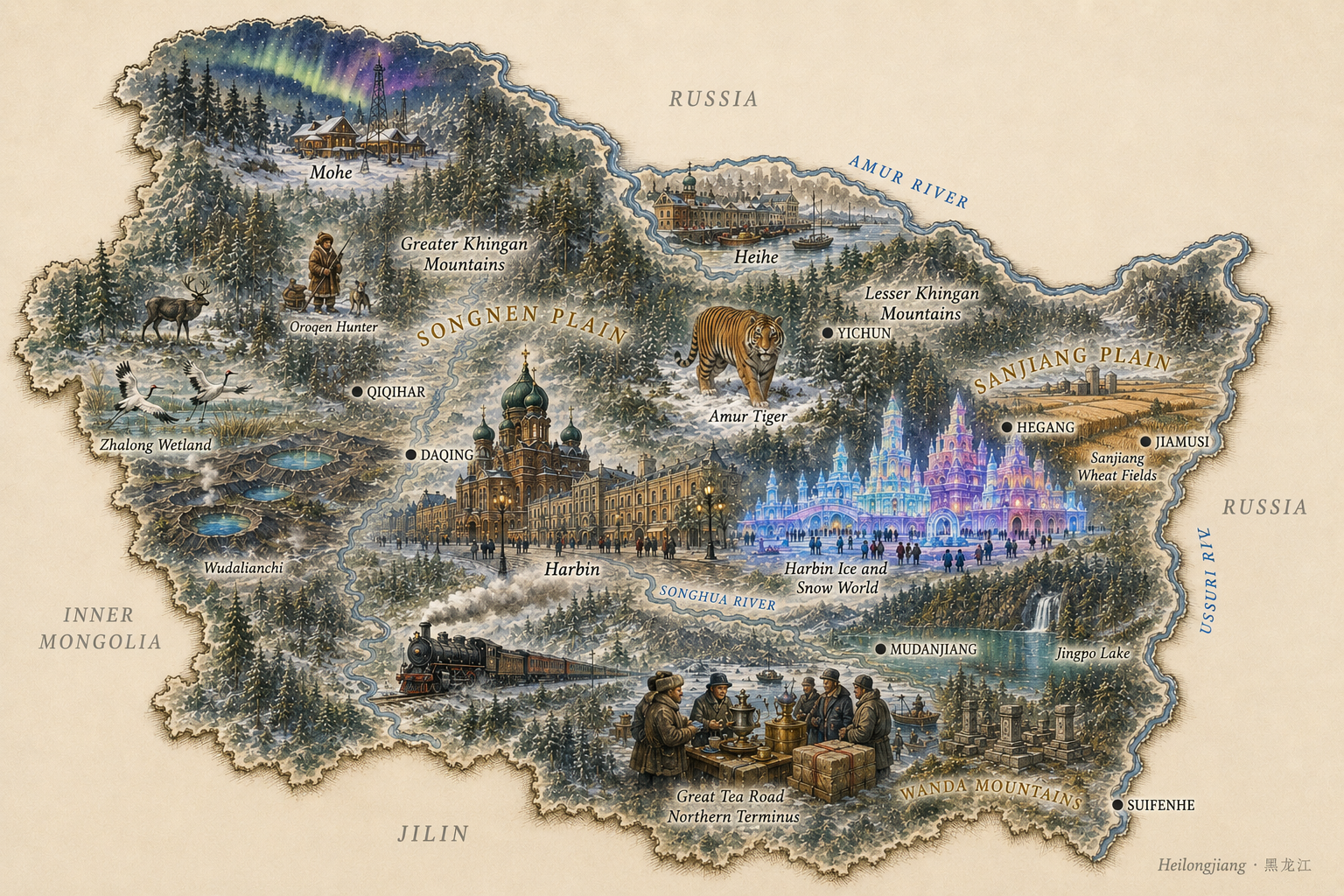
Heilongjiang is the northern terminus of the Great Tea Route, where Chinese tea bricks by the Amur were exchanged for Russian furs and silver. Harbin, with St. Sophia Cathedral — a legacy of Russian migration, where Russo-Chinese tea culture was born. The taiga of the Greater and Lesser Khingan ranges, the volcanic UNESCO Wudalianchi, the northern lights in Mohe — the least ‘tea-ish’ province, yet with a profoundly rich tea-trade context. Itinerary: Harbin with samovar culture → Ice World in winter → border town Heihe (Blagoveshchensk opposite) → Wudalianchi → Zhalong with cranes → Mohe with the northern lights.

Teas of this area

Самовар-чай Харбина 哈尔滨茶炊茶

A unique 19th–20th c. Russo-Chinese tea culture: Chinese black tea + Russian copper samovar + sugar + lemon. Harbin Jewish families (15,000 people in the 1920s) created this synthesis. Today — a reconstruction at the Samovar Museum.

Чай для Амурского обмена 黑龙江贸易茶

Hubei and Fujian brick tea reached Heihe by caravan, was ferried across the Amur by boat to Blagoveshchensk, and from there throughout Siberia. In 19th-century barter trade, one brick equalled one sable skin.

Травяные сборы тайги 黑土草药茶

The Evenki, Oroqen, and Nanai (indigenous peoples of Heilongjiang) drank herbal taiga infusions: rhododendron, eleutherococcus, schisandra, blackcurrant. Shamanic tea rituals — a legacy of millennia of coexistence with the taiga.

Route by days

  1. Дни 1–2

    Харбин · Софийский собор 哈尔滨·圣索菲亚大教堂

    Russian Legacy · Samovars

    Harbin (哈尔滨) — ‘Eastern Moscow’, founded by Russians in 1898 as a key station of the Chinese Eastern Railway. St. Sophia Cathedral (1907) — the largest Orthodox church in East Asia. Central Street — a pedestrian avenue with Art Nouveau architecture. Harbin Museum with its samovar collection. A tea session in Russo-Chinese style: black tea from a samovar with sugar and lemon, borscht, pelmeni with butter. The story of Harbin Jews — 15,000 people in the 1920s — and their central role in the tea and fur trade.

    Boutique hotel in an early 20th-century mansion — wooden ceilings, ceramic tiles
  2. День 3

    Ледовый мир Харбина 冰雪大世界

    Snow and Ice (Winter) · Summer: Rivers

    In winter (December–February): Harbin Ice World (冰雪大世界) — the world's largest ice park, 600,000 m², full-scale ice replicas of the Taj Mahal and the Eiffel Tower. Ice Tea House — inner walls made of ice, tea drunk from ice cups. In summer: a cruise on the Songhua River (松花江). Unit 731 War Museum (former Japanese biological centre) — a memorial to the victims.

    Harbin hotel

  3. День 4

    Хэйхэ · Благовещенск 黑河·中俄边境

    Border with Russia · Tea Exchange

    Heihe (黑河) — a border town on the Amur, opposite Russian Blagoveshchensk. The Border Trade Museum — a reconstruction of the 19th-century tea and fur exchange. One can visit Russia on a simplified visa (4–5 h). A tea meeting with Russian traders at the border market. A comparison: Chinese brick tea versus Russian loose-leaf — two worlds of a single trade. The Amur freezes in winter, allowing one to walk between the countries.

    Heihe hotel

  4. День 5

    Удалянчи · Вулканы 五大连池

    UNESCO Geopark

    Wudalianchi (五大连池, ‘Five Connected Pools’) — a UNESCO geopark, 14 volcanoes and 5 linked volcanic lakes. Eruptions in 1719 and 1721 — some cones appear freshly solidified. Mineral springs with healing water. A tea session on lava by a volcano. A comparison: Wudalianchi versus Uji (Japan) versus Yellowstone — three great geoparks of volcanic activity.

    Wudalianchi spa hotel

  5. День 6

    Чжалун · Журавли · Цицикар 扎龙湿地·齐齐哈尔

    Home of the Red-Crowned Crane

    Zhalong (扎龙) — Asia's largest reserve for red-crowned cranes (Grus japonensis), 2,100 km² of wetlands. 400 individuals — a quarter of the global population. The morning crane feeding in flight — the main spectacle. Qiqihar (齐齐哈尔) — the former capital of Heilongjiang, a Manchu fortress. A tea session with shamanic Evenki herbs: rhododendron, schisandra. An encounter with China's northernmost hunting peoples.

    Guesthouse by the reserve

  6. День 7

    Мохэ · Северный полюс Китая · Финал 漠河·北极村

    Aurora · Finale

    Mohe (漠河) — China's northernmost city, 53° N, ‘China's North Pole’ (北极村). Winter -50°C, summer polar day — the sun barely sets. The northern lights — the only place in China to see the aurora. A final tea session during the polar night: samovar + brick tea + taiga berries + Siberian honey. Stocking up on samovars and taiga herbs. A farewell to the Great Tea Route — here it comes to an end.

Planning

Transport
Fly into Harbin (HRB). Domestic flight to Mohe (OHE) — 2 hours. High-speed train between Harbin and Qiqihar. Minibus. VAST distances — 1,200 km from south to north.
Climate
The coldest province. Winter (November–March): -30–-50°C in the north. Summer (June–August): 18–28°C. Spring and autumn are short. Mohe in winter: -50°C, specialised kit needed. Best time for Mohe — summer (polar day) or December–January (aurora).
What to bring
WINTER: professional polar down parka (-40°C), valenki, 3-layer thermal underwear, balaclava, hand warmers. SUMMER: light clothing + mosquito protection. Always: a warm layer, a tea thermos, cash.
Buying tea
Harbin-made samovars: from ¥500. Museum-style tea bricks: from ¥100. Siberian herbs (schisandra, ginseng): from ¥150. North-eastern dried fruit. Evenki and Nanai amulets. North-eastern honey.