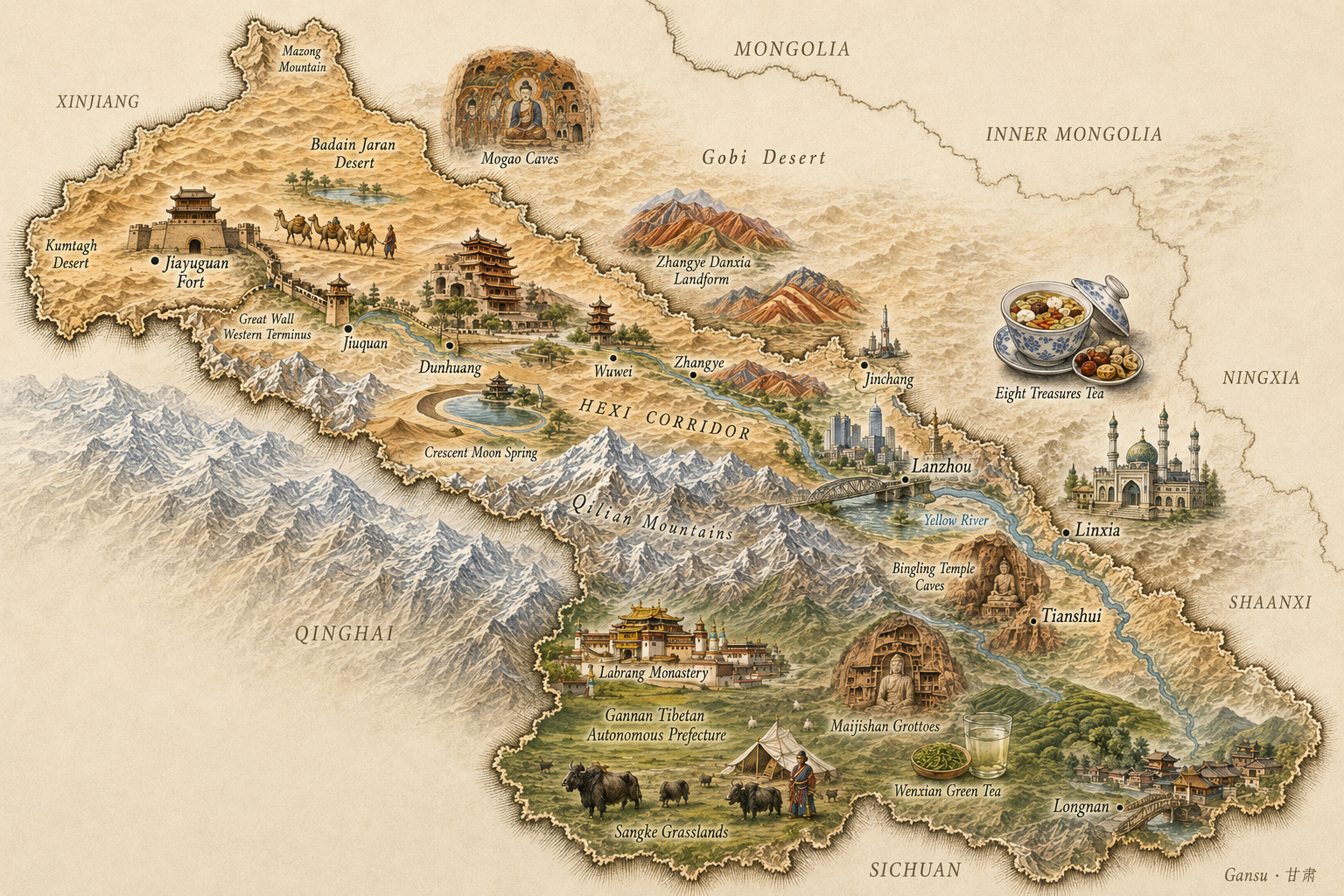
Gānsù · 甘肃省
Trade route · Silk Road · Sanpaotai · Dunhuang · Jiayuguan

Gānsù

甘肃省 · Gānsù

Where caravans went West, tea became the currency of the Silk Road

丝路茶韵

Gansu is a narrow corridor through which the Silk Road ran for 2,000 years, and with it the Tea Road to the West. Sichuan and Hubei tea departed from here to Central Asia, Persia and Byzantium. Here, sanpaotai (三炮台) is born — the tea of Hui Muslims in a three-piece vessel with eight treasures: goji berries, dates, jujube, nuts. Route: Mogao Caves in Dunhuang → Jiayuguan Fort (the western end of the Great Wall) → Zhangye Danxia → Maijishan Caves → Labrang Monastery of Tibetan Buddhists.

Teas of this area

Саньпаотай (Три пушки) 三炮台

Eight-treasure tea of the Hui Muslims: black or green tea + goji berries + red dates + rock sugar + dried chrysanthemums + crushed jujube + walnut + raisins. Served in a three-piece cup with a lid. Sweet, aromatic, warming — ideal for the desert.

Шёлковый путь чай 丝路茶

Tea as currency on the Silk Road: one brick of Hubei heicha was exchanged for a horse, a hide, or spices. The caravanserais of Dunhuang and Jiayuguan were nodal points where merchants sealed deals over a cup of sanpaotai.

Тибетский Лабранг чай 拉卜楞茶

Milk tea of Labrang Monastery — the largest Tibetan monastery outside Tibet. Po cha with yak butter for pilgrims. The boundary between the Tibetan and Hui tea worlds.

Route by days

  1. Дни 1–2

    Дуньхуан · Могао 敦煌·莫高窟

    Treasure-house of the Silk Road

    Dunhuang (敦煌) — an oasis on the Silk Road, UNESCO. Mogao Caves (莫高窟) — 735 caves with Buddhist frescoes from the 6th–14th centuries. Tang dynasty tea ceremony scenes on the walls. Shazhou Caravanserai — a reconstruction of the tea trade. Crescent Lake (月牙泉) and the Singing Sands — a nighttime tea session with sanpaotai on the dunes under the stars.

    Caravanserai-style guesthouse — courtyard, fountain

  2. День 3

    Цзяюйгуань · Великая Стена 嘉峪关

    Western End of the Wall

    Jiayuguan (嘉峪关) — the western fort of the Great Wall, UNESCO, the end of Chinese civilisation in imperial times. Great Wall Museum — exhibition 'Tea Caravans Through the Wall'. Frontier garrison tea house — a reconstruction of Ming dynasty soldiers' life. 'The Parting Place' — here exiles wrote their last verses before departing into the Gobi Desert.

    Hotel by the fort — walls illuminated at night

  3. День 4

    Чжанье Данься 张掖·七彩丹霞

    Rainbow Mountains

    Zhangye Danxia (张掖·七彩丹霞) — 'Rainbow Mountains', UNESCO Geopark. Coloured sandstones tinted by minerals 24 million years ago. Best photo — sunset. Tea picnic with a panorama of rainbow layers. Zhangye — an ancient city on the Silk Road, formerly Ganzhou. Giant Buddha (大佛寺) — a 35-metre reclining statue from 1098.

    Zhangye Guesthouse

  4. Дни 5–6

    Майцзишань · Линься 麦积山·临夏

    Wheat Stack Caves · Hui Capital

    Maijishan (麦积山) — 'Wheat Stack Mountain', UNESCO, 7,200 Buddhist statues on a sheer cliff. Hanging stairways — ascent 80 metres above ground. Linxia (临夏) — the largest center of Hui Muslims in the Northwest. Grand Mosque, carpet and tea market. Hui tea ceremony: three-piece vessel, eight treasures. Sanpaotai tasting in local Hui families.

    Hui guesthouse — white walls, blue doors

  5. День 6

    Лабранг · Тибетский монастырь 拉卜楞寺·夏河

    Largest Monastery Outside Tibet

    Labrang (拉卜楞寺) — the largest Tibetan Buddhist monastery outside Tibet, founded in 1709. Today 1,500 monks. Pilgrims' tea house — po cha with yak butter. Morning prayers in the Great Hall. Kora — circumambulation of the monastery with prayer wheels. The boundary between Hui sanpaotai and Tibetan po cha — two tea worlds converge.

    Lodge in Xiahe — Tibetan style

  6. День 7

    Ланьчжоу · Финал 兰州

    City of the Yellow River · Finale

    Lanzhou (兰州) — capital of Gansu on the banks of the Yellow River. Famous Lanzhou Lamian (兰州拉面) — a global hit. Jincheng Park — tea houses on the banks of the Huang He. Silk Road Museum — exhibition 'Tea and Silk Through the Gobi'. Final tasting: the evolution of sanpaotai from the Song dynasty to the present day. Purchase of Hui tea sets.

Planning

Transport
Arrival at Dunhuang (DNH) or Lanzhou (LHW). The Lanzhou–Ürümqi high-speed train runs through the entire province. Domestic flights for distant points. Vast distances — 1,600 km from east to west.
Climate
Sharply continental, desert-like. Summer: 25–38°C, very dry. Winter: -10 to +5°C. Spring and autumn are the best times. Sandstorms in spring. High UV — SPF50+.
What to bring
Light clothing + windbreaker (sharp temperature swings), dust mask, SPF50+, sunglasses, trekking shoes (Maijishan!), cash (terminals are rare), VPN for foreign services.
Buying tea
Hui sanpaotai sets: from 80 ¥. Eight treasures — dried fruit sets: from 150 ¥. Dunhuang silk scrolls with tea motifs: from 200 ¥. Tibetan zangcha at Labrang. Lanzhou lamian recipe collections.